
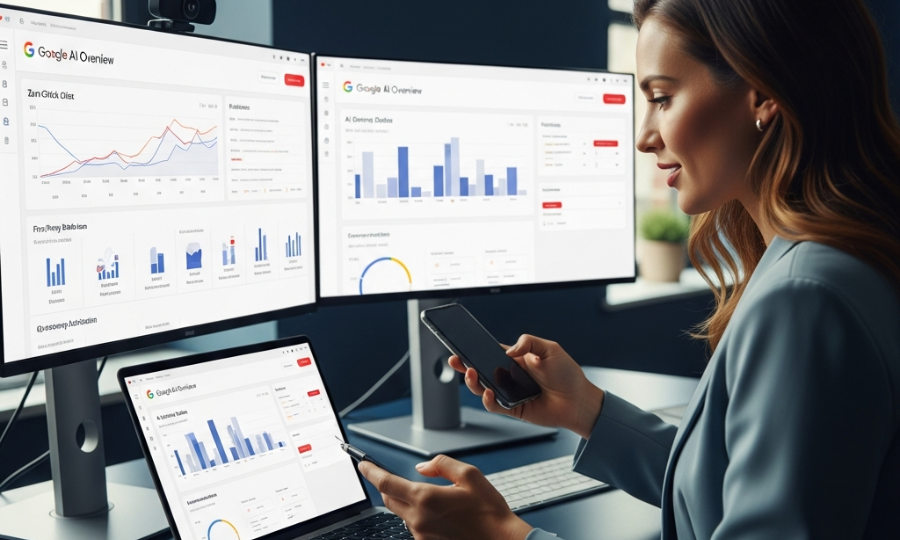
Your e-commerce business is built on clicks. Every traffic report, every conversion metric, ties back to a user making that crucial decision to visit your site. But what happens when Google delivers answers directly, often without a single click? This isn’t a hypothetical. It’s the ‘zero-click’ era, accelerated by Google’s AI Overviews, and it’s already draining revenue from businesses that haven’t adapted.
Key Takeaways
- Google’s AI Overviews are driving a ‘zero-click’ era, with SparkToro and Datos reporting that approximately 58.5% of US Google searches ended without a click in 2024.
- Traditional e-commerce ROI metrics focused solely on direct clicks are insufficient; businesses must now track AI citations, brand sentiment, and direct traffic lift.
- Failing to optimize for AI Overviews can lead to significant revenue loss, with Horizon Marketing estimating a potential loss of $15,000-$20,000 per month for SMBs missing 30-40 qualified leads.
- First-party data is crucial for understanding customer journeys and accurate attribution in the AI era, especially when direct clicks from search results decline.
Consider this: In 2024, approximately 58.5% of US Google searches and 59.7% of EU Google searches ended without a click, according to SparkToro and Datos research. That’s a staggering amount of user intent satisfied directly on the search results page, bypassing your website entirely. When AI Overviews appear, the impact is even more pronounced. Amsive found an average 15.49% click-through rate drop for keywords triggering AI Overviews. Observer research suggests paid search click-through rates could decline significantly, leading to a substantial drop in traffic for businesses relying on search advertising. This isn’t just a shift in how users find information; it’s a fundamental disruption to your e-commerce ROI, and it demands a new playbook.
The New Reality: Why Your Traffic Reports Lie
Traditional e-commerce success hinges on organic traffic. We’ve spent years optimizing for clicks, tracking them meticulously, and attributing revenue directly to those visits. But AI Overviews rewrite that equation. These generative summaries appear at the top of many search results, pulling content from multiple web pages to provide a concise, synthesized answer. Users get what they need immediately. They don’t have to click.
This means the clicks you do get are no longer the full story of your brand’s search performance. Ahrefs research indicates a substantial reduction in click-through rates for top-ranking pages when AI Overviews are present. Your content might be powering the AI Overview, yet you’re not seeing the direct traffic you once did. That’s a problem for your P&L, especially if you’re still measuring success solely on last-click attribution.
The cost of ignoring this shift is clear. Horizon Marketing highlights that a typical small to medium-sized business (SMB) could lose 30-40 qualified leads per month by being invisible in AI search. At a $500 close value, that’s $15,000-$20,000 per month in lost opportunity. You’re not just missing clicks; you’re missing revenue.
The Hidden Costs of Invisibility in AI Search
Failing to adapt to AI Overviews carries tangible financial penalties. First, there’s the direct loss of leads. If your brand isn’t cited in an AI answer, that lead often goes to a competitor. Horizon Marketing’s analysis points out that in AI search, users get one summarized answer, not a list of ten blue links. If your brand isn’t in that answer, you’ve lost the lead entirely.
Second, your existing marketing spend becomes less efficient. You’ve invested in content, SEO, and perhaps even paid search, all designed to drive clicks. When AI Overviews absorb those clicks, the return on that investment diminishes. Observer notes that rising acquisition costs are a challenge, as click-through rates decline and marketing budgets deliver fewer conversions at higher costs.
Third, there’s the erosion of authority and trust. AI models prioritize E-E-A-T (Experience, Expertise, Authoritativeness, Trustworthiness) when selecting sources. If your brand isn’t consistently appearing as a trusted source within AI Overviews, you’re ceding that authority to competitors who are. This isn’t just about traffic; it’s about your brand’s perceived credibility in the eyes of an increasingly AI-reliant audience.
Finally, there’s the widening competitive gap. Businesses that optimize for generative engine optimization (GEO) aren’t just winning today; they’re building a compounding advantage. A competitor can go from being tied with you to dominant in AI visibility within 12 months, according to Horizon Marketing. That’s a gap that becomes exponentially harder to close over time.
Beyond the Click: New Metrics for a New Era
Measuring e-commerce ROI in the AI Overview era demands a shift in focus. You can’t rely solely on direct clicks. You need to track new metrics that reflect brand visibility and influence within AI-generated answers. This means moving beyond traditional analytics to understand how often your brand is mentioned, how it’s described, and the indirect impact on your business.
Track AI Citations and Presence
AI citations are the mentions of your brand, content, or website within AI-generated answers. This is the new ‘position zero.’ Yext, for example, emphasizes tracking ‘presence’—whether your brand is showing up at all when AI platforms generate answers. This involves monitoring how often your pages are directly cited or linked in AI responses compared to competitors. More citations signal that AI systems trust your content as a reliable source.
You also need to measure your ‘share of voice’ within AI Overviews. This means understanding how much space your brand occupies across important prompts and topics. A higher share of voice indicates your brand appears more often during customer research. Tools like Brandpoint Optimize™ offer insights into where your brand appears in AI-generated answers and provide guidance on how to improve that visibility.
Monitor Brand Sentiment and Direct Traffic Lift
AI engines don’t just regurgitate information; they interpret and frame it. That means how your brand is described in an AI Overview matters as much as its inclusion. Yext’s framework includes ‘sentiment’ as a key metric, identifying whether AI platforms describe your brand positively or negatively. Are you framed as a trusted option or a budget choice? Are attributes like reliability or customer service part of the conversation? This sentiment directly impacts brand perception, even if a click doesn’t immediately follow.
Even without a direct click from an AI Overview, increased brand visibility can lead to a lift in direct traffic. Users exposed to your brand in an AI summary might later navigate directly to your site or conduct a branded search. This ‘assisted conversion’ pathway is crucial to track. It requires sophisticated attribution models that look beyond the last click to understand the full customer journey.
Leverage First-Party Data for Deeper Insights
The deprecation of third-party cookies makes first-party data more critical than ever for accurate attribution and personalization. First-party data is information your business collects directly from its customers and audiences through its owned channels, like website interactions, purchase history, and email subscriptions. This data is highly accurate and reliable.
With AI Overviews reducing direct clicks, first-party data becomes your compass for understanding user behavior and campaign effectiveness. It allows you to track customer journeys and identify which touchpoints influence decisions, even if the initial exposure was through an AI Overview. Emotive highlights that first-party data gives you the best chance at accurate attribution, leading to more informed decisions about market segments and potentially higher ROI. Forbes also emphasizes that first-party data is the key to unlocking personalized experiences that boost loyalty and sales.
Our own Internete Tracker platform helps businesses collect and analyze first-party data without relying on third-party cookies. It gives you a clear picture of visitor behavior and marketing attribution, essential for navigating the complexities of AI-driven search. By understanding customer behavior and preferences, businesses can tailor their messaging and product recommendations, improving customer engagement and conversion rates, per Emotive.
Building Your AI-Ready Measurement Stack
Adapting your e-commerce measurement strategy for AI Overviews means investing in tools and processes that capture value beyond the click. This isn’t about ditching SEO; it’s about evolving it to include generative engine optimization (GEO).
Optimize Content for AI Extraction
AI Overviews pull content from multiple sources to synthesize answers. To increase your chances of being cited, your content needs to be structured for easy extraction. This means starting with a direct answer in the first one to two sentences, using bullet points or numbered lists, and structuring content with clear headings (H2s, H3s). Google Search Central confirms that fundamental SEO best practices remain relevant for AI features, with no additional special optimizations strictly necessary, but good content structure helps.
Focus on creating comprehensive, topic-specific content that thoroughly answers user queries. Showcase first-hand experience and expertise to enhance credibility, making your content more likely to be featured in AI Overviews, as advised by Finch. Our Bligence platform can help generate, optimize, and publish SEO-ready articles with brand voice control, ensuring your content is structured for both human readers and AI systems.
Enhance Engagement for AI-Driven Visitors
Even if a user doesn’t click directly from an AI Overview, they might arrive on your site through a branded search or direct navigation after seeing your brand mentioned. Once they’re on your site, you need to engage them effectively. Solutions like Internete Chat can engage website visitors in real time, answer questions, capture leads, and even book appointments around the clock. This is crucial for converting visitors who might be further down the funnel, having already received some information from an AI Overview.
For those who prefer to call, ensuring every inquiry is handled is paramount. Missed calls represent lost opportunities. Our Internete Voice AI-powered phone system answers calls 24/7, qualifies leads, and routes urgent inquiries to your team instantly. This ensures that the brand awareness generated by an AI Overview translates into actionable engagement, regardless of the channel.
Streamline Lead Capture and Management
The journey from AI Overview to conversion might involve various touchpoints. When users are ready to convert, your lead capture process needs to be seamless. Internete Leads automates lead processing, capturing form submissions across all channels, filtering spam, and delivering qualified leads to your CRM instantly. This system ensures that every valuable lead generated, whether directly or indirectly influenced by an AI Overview, is captured and nurtured efficiently.
Optimizing for AI Overviews also means providing clear, structured product information. Go Fish Digital notes that AI Overviews prioritize concise, structured product information, such as details, pricing, and user reviews. Using schema markup ensures your data is properly formatted and ready for AI processing, increasing your chances of being featured. This level of detail helps AI systems understand your offerings and present them accurately to users.
Act Now: Secure Your E-commerce Future
The shift to AI Overviews isn’t a future trend; it’s a present reality with quantifiable impacts on e-commerce ROI. Businesses that cling to outdated measurement models risk significant revenue loss and competitive disadvantage. You can’t afford to be invisible in AI search.
Start by auditing your current content for AI readiness. Are your answers direct? Is your data structured? Are you building topical authority? Implement robust first-party data tracking with platforms like Internete Tracker to understand the full customer journey, including those influenced by AI Overviews. Deploy AI-powered engagement tools like Internete Chat and Internete Voice to capture and qualify leads efficiently, regardless of how they initially discovered your brand.
This isn’t about fighting AI; it’s about leveraging it. Embrace the new rules of search to ensure your e-commerce brand not only survives but thrives in the zero-click era. The investment in AI-ready strategies now will pay dividends in sustained visibility, qualified leads, and measurable revenue growth.
Sources
- Forbes — The Power Of Personalization: How To Use First-Party Data In E-Commerce
Related Reading
Frequently Asked Questions
How do Google AI Overviews impact e-commerce traffic?
Google AI Overviews provide direct answers on the search results page, reducing the need for users to click through to websites. This can lead to a significant decline in direct organic traffic, as observed by Amsive with a 15.49% average CTR drop for keywords triggering AI Overviews. Businesses must adjust their strategies to account for this shift.
What new metrics should e-commerce businesses track in the AI search era?
E-commerce businesses should move beyond traditional click metrics to track AI citations (how often their brand is mentioned in AI answers), brand sentiment (how AI describes their brand), and direct traffic lift (increases in direct website visits or branded searches after AI exposure). These metrics provide a more holistic view of brand visibility and influence in the AI era.
Why is first-party data so important with AI Overviews?
First-party data, collected directly from your customers, is essential because it provides accurate and reliable insights into customer behavior and preferences. As AI Overviews reduce direct clicks, first-party data allows businesses to track full customer journeys, understand attribution, and personalize marketing efforts, as highlighted by Emotive.
How can businesses optimize their content to appear in Google AI Overviews?
To optimize for AI Overviews, businesses should structure their content for easy extraction by AI. This includes starting with direct answers, using bullet points and clear headings, and providing comprehensive, topic-specific information. Showcasing expertise and using schema markup also increases the likelihood of being cited in AI-generated answers, according to Finch and Go Fish Digital.
This article was drafted with AI assistance. Please verify all claims and information for accuracy. The content is for informational purposes only and does not constitute professional advice.
