
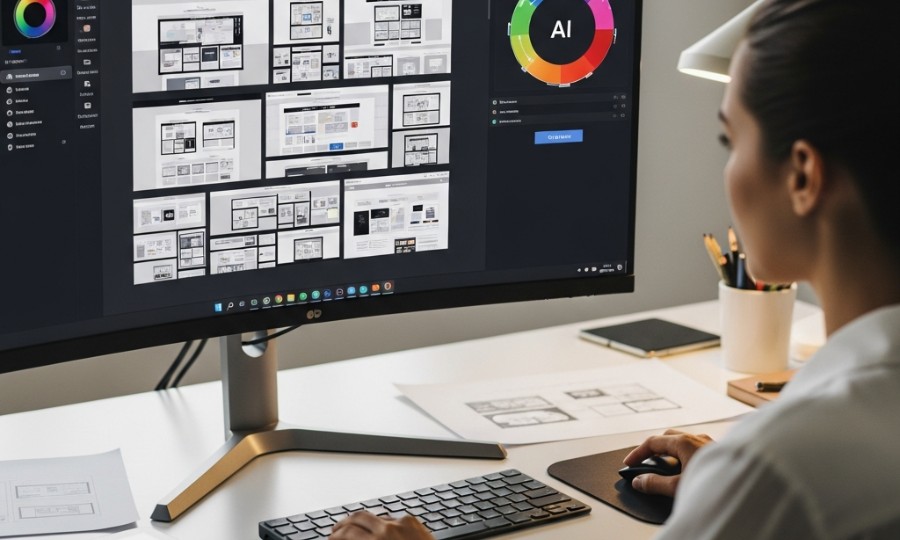
Remember when websites felt like static brochures, offering a one-size-fits-all experience? You’d navigate through rigid menus, hoping to stumble upon what you needed. Well, those days are quickly fading into the rearview mirror, aren’t they? Today, users expect more: they want interfaces that understand them, anticipate their needs, and adapt to their unique preferences. Here’s the thing: this isn’t just about better design anymore; it’s about artificial intelligence (AI) fundamentally reshaping how we approach user experience (UX) and user interface (UI) design, pushing the boundaries of what’s possible and, frankly, making our digital lives a whole lot smoother.
We’re not talking about dystopian sci-fi scenarios here. We’re talking about practical, impactful applications of AI that are already transforming web experiences, boosting engagement, and driving conversions. It’s an exciting time, but it can also feel a little overwhelming to keep up, can’t it? Let’s unpack how AI isn’t just a buzzword but a powerful co-pilot for designers, creating future web experiences that truly resonate with American users and beyond.
The Evolution of Experience: How AI is Reshaping UX/UI Foundations
For years, UX/UI design relied heavily on user research, A/B testing, and established design principles. While these methods remain crucial, they often involve a degree of generalization. We’d design for personas, which are valuable, but still represent an average user. The challenge has always been scaling that personal touch to millions of users. This is precisely where AI steps in, offering a leap forward from rule-based systems to truly dynamic, data-driven design.
Think about it: traditional UX often involves a designer making educated guesses about user behavior, then validating those guesses. AI, however, can observe, learn, and adapt in real-time. It can process colossal amounts of user data—click paths, scroll depth, time on page, even sentiment analysis from reviews—at speeds no human team ever could. This allows for a deeper, more granular understanding of individual user preferences and pain points. For example, consider an e-commerce site where AI analyzes not just your past purchases, but also your browsing patterns, the items you lingered on, and even how you react to different promotional layouts. It’s moving beyond simple recommendations to predicting your next interaction, almost before you even know you want it.
This isn’t about replacing the human designer; it’s about empowering them with unprecedented insights. AI can identify subtle patterns in user behavior that might take human researchers weeks or months to uncover, if at all. This frees up designers to focus on higher-level strategic thinking, creativity, and the nuanced emotional aspects of design that only humans can truly master. It’s about making design more intelligent, more responsive, and ultimately, more effective.
Intelligent Personalization: Crafting User Journeys That Truly Convert
In today’s crowded digital landscape, generic experiences just don’t cut it. Users are accustomed to highly personalized interactions, thanks to platforms like Netflix or Spotify. But AI is taking this to an entirely new level in UX/UI. It’s not just about remembering your name or your last order; it’s about anticipating your needs, adapting interfaces on the fly, and creating a user journey so seamless it feels almost intuitive.
Consider an online learning platform. Instead of a standard course curriculum, AI can dynamically adjust the learning path based on a student’s progress, their learning style (visual, auditory, kinesthetic), and even their engagement levels with specific types of content. If a student consistently struggles with a particular concept, the AI might suggest supplementary materials, offer interactive quizzes, or even rephrase explanations in a different format. This adaptive approach ensures a truly individualized learning experience, significantly improving retention and comprehension. Or, think about your banking app. An AI-powered UX could learn your spending habits, proactively suggest budgeting tools when it notices an unusual expense, or even simplify complex investment options based on your declared risk tolerance, making financial management less daunting.
The truth is, this level of personalization isn’t just a ‘nice-to-have’ anymore; it’s becoming a ‘must-have’ for businesses aiming for higher conversion rates and deeper customer loyalty. By leveraging AI to understand and cater to individual user preferences, designers can craft experiences that aren’t just aesthetically pleasing, but deeply engaging and remarkably effective, leading to stronger relationships between users and brands. You might wonder if this makes things too complex, but in most cases, AI simplifies the user’s perception of complexity by handling it behind the scenes.
Streamlining Workflows: AI as the Designer’s Co-Pilot
Beyond enhancing the end-user experience, AI is also proving to be an invaluable asset within the design workflow itself. Let’s be honest, parts of the design process can be repetitive and time-consuming, pulling designers away from truly creative problem-solving. This is where AI-powered tools are stepping in, acting as intelligent co-pilots that automate mundane tasks, accelerate iteration cycles, and even offer predictive insights.
Imagine a design tool that can analyze your existing design system, identify inconsistencies, and suggest optimal adjustments for elements like button sizes, typography, or color palettes to ensure visual harmony and brand consistency. It can even perform automated accessibility checks, flagging potential WCAG violations for color contrast or font readability before a design ever leaves the prototype stage. This isn’t just about speed; it’s about ensuring a higher quality, more compliant product from the outset. Also, AI can take on the heavy lifting of A/B test analysis, sifting through mountains of data to pinpoint which design variations perform best and, more importantly, why they perform best, providing actionable insights for optimization.
Could AI actually make us more creative? I believe so. By offloading the grunt work—things like generating multiple layout options based on predefined constraints, optimizing image sizes, or even suggesting content snippets—designers are freed up to tackle the more complex, human-centric challenges. They can spend more time on empathy mapping, understanding user psychology, and innovating truly novel solutions, rather than being bogged down by pixel-pushing. It’s about augmenting human ingenuity, not replacing it, allowing designers to focus on what they do best: creating meaningful and impactful experiences.
Predictive Design and Proactive Engagement: Anticipating User Needs
One of the most exciting frontiers in AI-driven UX/UI is its ability to move beyond reactive design to truly predictive and proactive engagement. Rather than waiting for a user to encounter a problem or search for information, AI can anticipate their needs and guide them seamlessly through an experience, often before they even realize they need assistance. This feels a bit like having a helpful, invisible assistant guiding your journey, doesn’t it?
Think about a smart home application. An AI-powered interface could learn your daily routines and preferences, automatically adjusting lighting, temperature, or even suggesting a specific playlist as you arrive home. It’s not just about scheduling; it’s about recognizing patterns and acting on them. In a customer service context, AI-driven chatbots are becoming incredibly sophisticated. Instead of merely answering direct questions, they can analyze your past interactions, current browsing behavior, and even the context of your query to offer relevant information or solutions before you’ve fully articulated your problem, reducing frustration and improving resolution times. This isn’t just about efficiency; it’s about building trust and demonstrating a deep understanding of the user.
Another powerful example lies in adaptive interfaces. Imagine a mobile banking app that, based on your location and time of day, automatically prioritizes features like quick transfers when you’re at a store, or bill pay options when it’s nearing the end of the month. Or a healthcare portal that highlights prescription refill reminders or upcoming appointment details based on your personal health timeline. These proactive shifts in UI elements make the experience incredibly relevant and user-friendly. We know this feels a bit like science fiction, but it’s happening, making digital interactions feel less like navigating a system and more like a helpful conversation.
So, what does all this mean for you, whether you’re a designer, a developer, or a business leader? AI isn’t just another tool in the UX/UI arsenal; it’s a paradigm shift. It’s enabling us to move from designing for the masses to designing for the individual, creating deeply personalized, intuitive, and efficient digital experiences. The key isn’t to fear AI, but to understand its potential and integrate it thoughtfully into our processes. By embracing AI, we’re not just improving interfaces; we’re crafting more engaging, more human-centric web experiences that drive real value for users and businesses alike. The future of UX/UI isn’t just bright; it’s intelligently designed. So, are you ready to design the future?
Start Growing with
NYC’s AI Powered Digital Marketing Agency.
Unlock the power of AI-optimized blogs and proven strategies.
From SEO & PPC to conversion-focused design,
Internete builds the growth engine your business deserves.
