
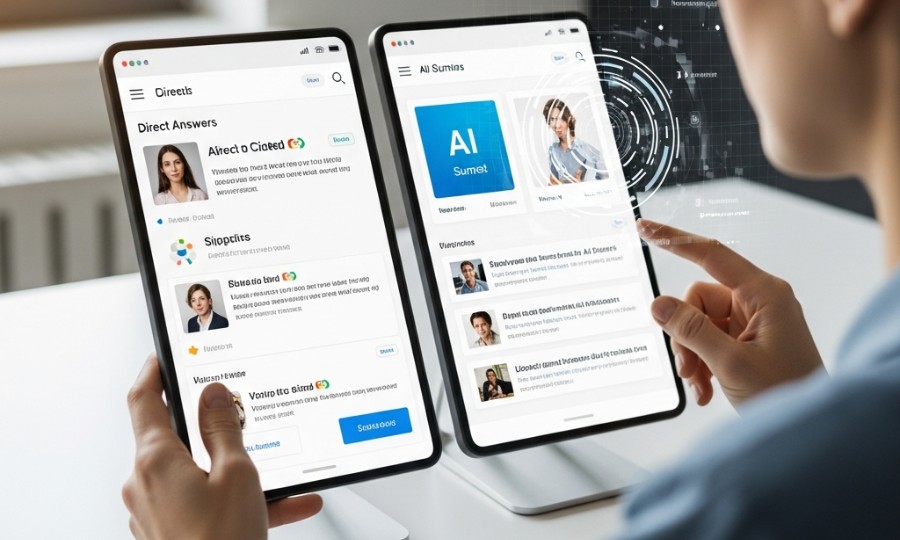
Remember when searching the internet meant typing a query into Google and getting a list of ten blue links? You’d click, scroll, and often click again, piecing together information from various sources. It’s a method we’ve all grown accustomed to, but let’s be honest, it can be a significant time sink, especially when you’re just looking for a straightforward answer.
Well, the search landscape is rapidly changing. A new player, Perplexity AI, has emerged with a bold promise: to give you direct, cited answers, essentially acting as an “answer engine” rather than a traditional search engine. It’s an intriguing concept, isn’t it? And one that’s certainly shaking things up. But is it truly the silver bullet we’ve been waiting for, or is Google’s own evolution with AI Overviews (formerly Search Generative Experience, or SGE) still the reigning champion?
In this deep dive, we’re going to unpack the ‘answer engine’ revolution, comparing Perplexity AI’s unique approach with Google’s formidable response. We’ll look at what makes each tick, explore their strengths and weaknesses, and help you figure out which one might be your go-to for finding information in this new era.
Perplexity’s Promise: The “Answer Engine” Advantage
Perplexity AI isn’t just another search engine; it’s designed to fundamentally change how you interact with online information. When you ask Perplexity a question, you don’t get a list of links to wade through. Instead, you get a concise, direct answer generated by AI, complete with inline citations to its sources. It’s like having a highly efficient research assistant summarize the internet for you, pointing directly to where it found its information.
This focus on direct answers and transparent sourcing is a game-changer for many users. Imagine you’re trying to understand a complex topic, like the specifics of the latest IRS tax changes for small businesses, or the legal requirements for starting a non-profit in your state. Instead of sifting through dozens of government websites and legal blogs, Perplexity aims to provide you with a synthesized answer, immediately showing you which official documents or reputable publications it pulled from. This transparency, I believe, is a huge step forward in combating misinformation, as you can easily verify the claims yourself. You’re not just trusting an algorithm; you’re seeing its homework.
For students, researchers, or anyone needing quick, verifiable facts, Perplexity feels incredibly efficient. It streamlines the information gathering process, potentially saving you valuable time and mental energy. It’s like cutting through the noise to get straight to the signal.
Google’s Response: AI Overviews and the Shifting Landscape
Google, not one to be left behind, has been hard at work integrating its own generative AI capabilities directly into its search results. Their answer to the ‘answer engine’ phenomenon is AI Overviews, which aims to provide AI-generated summaries at the top of many search results pages. You’ve probably seen them pop up when searching for recipes, travel information, or even explanations of scientific concepts.
Google’s AI Overviews often pull information from multiple sources on the web, trying to provide a comprehensive, albeit summarized, response right at the top. Below the overview, you’ll still find the familiar list of traditional links, allowing you to dive deeper if the summary isn’t enough. It’s an evolution, not a complete revolution, maintaining Google’s core identity as a gateway to the web, rather than an endpoint.
The integration of AI Overviews into Google Search is certainly powerful, leveraging Google’s unparalleled index of the internet. However, it hasn’t been without its controversies. Early iterations sometimes generated questionable or even outright incorrect information, leading to public scrutiny and concerns about accuracy. Google has since made efforts to refine this feature, but the trust factor is still a work in progress for some users. Do you feel completely confident in an AI-generated summary that might not always clearly cite every single piece of its information, especially compared to Perplexity’s more explicit source model? It’s a legitimate question, and one that highlights a key difference in their approaches.
Diving Deeper: Accuracy, Transparency, and User Experience
When we talk about information retrieval, accuracy and transparency are paramount, especially for an American audience accustomed to critical thinking and fact-checking. Perplexity’s strength lies in its explicit citation model. You can see the specific websites, research papers, or news articles that informed its answer. This makes it incredibly useful when you need to confirm facts or understand the origin of information.
For instance, if you’re researching the efficacy of a new health trend, Perplexity will likely point you to specific scientific studies or reputable health organizations. Google’s AI Overview might provide a summary, but tracing its exact sources can sometimes feel a bit more opaque, requiring more effort to click through and verify. In a world increasingly concerned about deepfakes and misinformation, this level of transparency isn’t just a nice-to-have; it’s critical.
However, Google’s vast ecosystem still offers a different kind of value. For many queries, particularly those with commercial intent (like “best hiking boots” or “pizza places near me”), Google’s integrated maps, shopping results, and local business listings provide a comprehensive experience that Perplexity doesn’t yet match. It’s also generally better at understanding conversational queries and providing a broader range of content types beyond just text answers, like images, videos, and news feeds. In my experience, if I’m looking for a quick definition or a simple fact, Perplexity is lightning fast. But if I’m planning a trip or buying a new appliance, Google’s comprehensive ecosystem still feels more robust.
Who Wins? Understanding Your Search Needs
So, which one is better? The truth is, there’s no single winner. It really depends on what you’re trying to accomplish. If your goal is to get a quick, well-sourced answer to a factual question, especially on complex or academic topics, Perplexity AI often shines. Its commitment to transparent citations empowers you to verify information and delve deeper into primary sources with ease. It’s perfect for when you need to quickly get up to speed on a topic or find specific data points.
On the other hand, if you’re looking for a broader exploration of a topic, seeking out product reviews, comparing shopping options, or trying to find local businesses, Google’s traditional search experience, augmented by AI Overviews, often provides a more comprehensive and integrated solution. Its ability to incorporate different media types and its deep understanding of commercial intent queries make it incredibly versatile for everyday browsing and consumer needs. You might be thinking that Google’s sheer size gives it an unfair advantage, and in some ways, it does, especially in terms of data indexing and existing user habits.
The Future of Finding Information
This evolving landscape suggests a future where search isn’t a one-size-fits-all experience. We’re moving towards a more nuanced approach where different tools cater to different informational needs. Perplexity AI represents a powerful shift towards instant, verifiable answers, pushing the boundaries of what an “answer engine” can be. Google, with its AI Overviews, is adapting its colossal engine to provide more direct answers while retaining its comprehensive web-discovery capabilities.
What does this mean for you? It means you now have more choices, which is always a good thing, right? We’re no longer confined to just one way of finding information. The competition between these innovative approaches will undoubtedly drive further advancements, making online information more accessible, more accurate, and ultimately, more useful.
My belief is that the most savvy internet users will learn to leverage both. You’ll use Perplexity when you need quick, cited facts for a report or a debate, and you’ll lean on Google when you’re planning your weekend, comparing consumer electronics, or exploring new hobbies. The key is understanding their respective strengths and integrating them into your workflow. So, what’s your next move going to be? Are you ready to try out this new era of information retrieval?
Actionable Next Steps
Ready to experience the answer engine revolution yourself? Here’s what you can do:
- Try Perplexity AI: Visit Perplexity.ai and ask it a complex question you’ve been pondering. Pay attention to the citations it provides. How does it compare to your usual search habits?
- Observe Google’s AI Overviews: When you use Google Search, notice when AI Overviews appear. Evaluate their usefulness and accuracy. Do they answer your question effectively, or do you still need to scroll for more details?
- Mix and Match: Experiment with using both tools for different types of queries. You might find Perplexity is excellent for research, while Google remains your go-to for local information or shopping.
- Stay Informed: The world of AI is moving fast! Keep an eye on tech news and official announcements from both companies to understand new features and improvements.
This article was drafted with AI assistance. Please verify all claims and information for accuracy. The content is for informational purposes only and does not constitute professional advice.
